
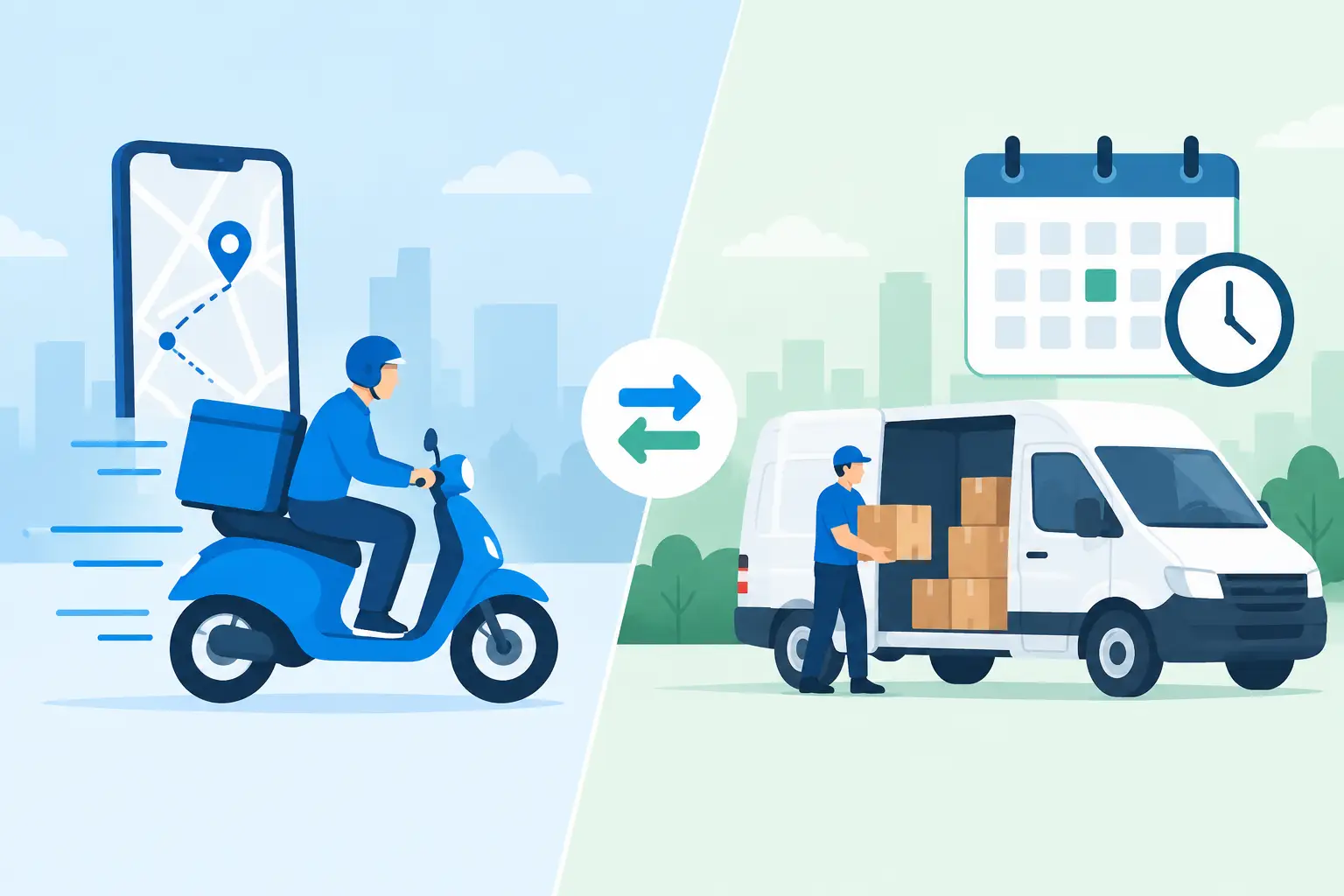
The difference between on-demand delivery versus scheduled courier services becomes very real when your passport is sitting at home and your flight is in a few hours. Or when a customer needs a replacement item today, a set of keys has been left in the office, or an event is missing one essential box of supplies. At that point, the question is not simply how to send something. It is how quickly someone can collect it, tell you the price, and get moving.
Both services have a place. A scheduled courier is useful when the job is planned and timing is flexible. An on-demand service is built for the jobs that appear without warning, where waiting until tomorrow is not an option.
On-demand delivery versus scheduled courier: the main difference
A scheduled courier works to a pre-arranged collection slot, route or service timetable. You book ahead, provide collection and delivery details, and the parcel joins a planned run. That can be a sensible, cost-conscious choice for regular stock movements, non-urgent documents or items that can comfortably arrive the next day.
On-demand delivery starts with the need happening now. You submit the job, receive a price up front, pay, and a driver is dispatched for collection as fast as possible. Rather than fitting your item into a future route, the service is organised around the urgency of that particular request.
This is not just a question of delivery speed. It changes the whole experience. With a scheduled service, you may be working around cut-off times, booking windows and available slots. With on-demand collection, the focus is immediate assessment: where is the item, where does it need to go, and what is the fastest practical way to make it happen?
For an urgent job, that clarity matters. You do not want to spend an hour comparing delivery options only to learn that collection is tomorrow afternoon.
When a scheduled courier is the right choice
Scheduled courier services are not the slow option by default. They are the planned option. If your business sends routine orders every weekday, moves stock between locations each week, or has documents that need to arrive by a known date, booking ahead can give you predictability and may reduce the price per job.
They also suit consignments where someone will be available at a fixed collection time and the receiver does not need the item immediately. A retailer arranging a standard supplier return, for example, may have no reason to pay for priority collection. The same is true for a household sending a non-urgent parcel to a relative.
The trade-off is flexibility. A booked slot is useful until the situation changes. If the collection address is inaccessible, the recipient suddenly needs the item earlier, or a forgotten item becomes urgent after the booking cut-off, a standard route may not have room to adapt.
Scheduled services can also involve more administration. Businesses may need to manage labels, account processes, depot handovers and collection windows. None of that is a problem when the job is repeatable. It is less helpful when you are standing outside a pharmacy, hotel or office trying to solve a problem before the day gets away from you.
When on-demand delivery earns its keep
On-demand delivery is for the moment when delay costs more than the delivery itself. That cost might be financial, but it is often practical or personal. Missing a flight because a passport is in the wrong place is expensive. Being locked out because your keys are across town is stressful. A restaurant without a critical ingredient before service has a problem that cannot be parked until the next collection round.
The strongest use cases tend to share three things: the item is ready to collect, the destination is known, and time matters. A driver can collect a forgotten mobile phone from home and bring it to an office. A pharmacy order can be collected for somebody who cannot travel. A marketplace purchase can be picked up while the seller is available. A marketing agency can send event materials to a venue before doors open.
For businesses, on-demand transport is particularly useful when the exception becomes the priority. A corporate office may have a signed document that must reach another location today. A retailer may need an urgent transfer from one branch to another. A hotel may need lost luggage sent to a guest who has already travelled on. These are not always daily jobs, but when they occur, they need a response rather than a booking form designed for next week.
We Fetch is built around that response: send the request, receive an upfront quote within minutes, pay, and have a driver assigned for rapid collection. The aim is simple - remove the chasing, uncertainty and delay from a job that already needs attention.
Speed is more than the time in transit
People often compare courier services by asking, “How long will the delivery take?” That is the right question, but it is incomplete. Total time includes the wait before collection, the time spent getting a quote, the time needed to confirm the booking, and any handovers along the way.
A parcel may travel quickly once it has reached a depot, yet still take a day or two to arrive because it was not collected promptly. For an urgent delivery, collection speed is often the deciding factor. An item still sitting on a kitchen table or in a shop stockroom is not making progress.
That is why direct, point-to-point collection changes the outcome. A driver is sent to the item rather than waiting for a general collection route. The route can then be planned around the actual collection and delivery addresses, rather than a wider network of scheduled stops.
Traffic, distance, weather and access still matter. No responsible courier should promise that every job will take the same amount of time. But an on-demand provider should be clear about what can be done, give a price before you commit, and move quickly once the job is confirmed.
Cost: paying for urgency versus paying for efficiency
On-demand delivery will often cost more than a standard scheduled service. That is fair. Rapid dispatch, dedicated attention and flexible routing have a value, particularly when the request comes with little notice.
The better comparison is not always courier price against courier price. It is the delivery cost against the cost of not acting. Replacing a lost passport, rearranging a missed appointment, delaying an event setup or losing a same-day sale can quickly outweigh the price of urgent collection.
For a business, it can also protect customer relationships. If the wrong product has gone out, a time-sensitive sample needs to reach a client, or a key piece of equipment has been left behind, a fast recovery can turn a bad experience into a well-handled one.
That does not mean every item needs an express driver. If the item can wait, schedule it. If the job has a fixed routine, organise a regular collection arrangement. But if the timing is the problem, choosing the cheapest service can be a false economy.
How to choose the right service for the job
Start with one honest question: what happens if this item is not collected today? If the answer is “nothing much”, a scheduled courier is probably the sensible choice. If the answer involves a missed journey, an unhappy customer, a closed venue, a delayed prescription or someone stranded without keys, on-demand collection is likely the better fit.
Then check the practical details. Is the item packed or ready for handover? Is someone available at the collection point? Does the recipient know to expect the driver? Do you have accurate addresses, contact numbers and any access instructions? A clear request helps a courier assess the job quickly and avoid wasted time at either end.
It also helps to describe the item properly. A document, bakery order, suitcase, fragile marketplace purchase and bag of pharmacy items do not all need the same handling. If there is a temperature concern, a large or awkward item, a collection from a veterinary practice, or an unusual delivery instruction, say so at the outset. The right service should be able to assess the request rather than forcing it into a generic parcel category.
Choose urgency with purpose
Scheduled courier services keep planned deliveries moving. On-demand delivery handles the moments that cannot be planned: the item left behind, the customer waiting, the deadline approaching, the problem that needs a practical answer now.
When time is the thing you are really sending, get the details ready, ask for the upfront price, and put a driver on the job.