
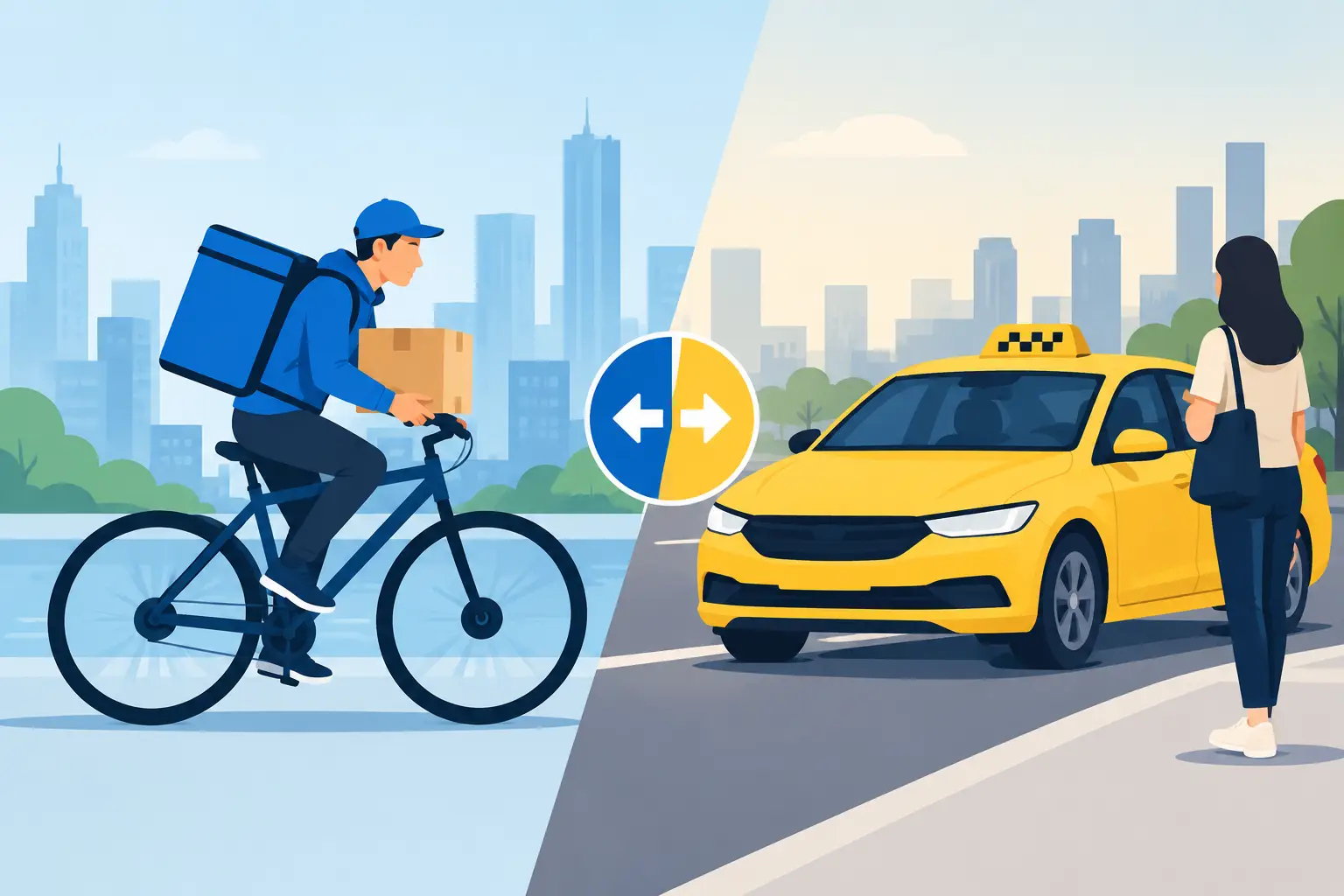
A mobile phone is on the kitchen table and its owner is already halfway to the airport. A signed document needs to reach a client before close of business. A restaurant has run out of a key ingredient just before a busy service. In these moments, the same-day courier versus taxi question is not really about getting from A to B. It is about whether the item will be collected properly, carried safely and handed to the right person without creating a second problem.
A taxi can sometimes be a quick fix, especially for a straightforward local journey. But a dedicated same-day courier is built around the job itself: collection, delivery, communication and proof that the item has reached its destination. The better choice depends on what you are sending, how urgent it is and how much certainty you need.
Same-day courier versus taxi: the real difference
The obvious similarity is speed. Both taxis and couriers use drivers who know local roads and can respond quickly. If a colleague is travelling with the parcel, a taxi may be perfectly sensible. The passenger can keep hold of the item, give directions and make sure it is handed over.
The situation changes when the item needs to travel on its own. A taxi service is designed primarily to move passengers. A same-day courier service is designed to move goods, documents and personal items from one person or location to another. That affects everything from the booking process to the driver brief and delivery confirmation.
With a courier, the collection is part of the service. The driver can go into a shop for a click-and-collect order, collect keys from a family member, pick up a prescription from a pharmacy or retrieve a forgotten laptop from an office. They then take the item directly to the named recipient or agreed safe handover point.
A taxi driver may be willing to help, but the level of service can vary. Will they collect from a counter that needs an order number? Will they wait if the item is not ready? Can they confirm the recipient's identity? Are they insured or set up to carry a high-value business item? These are questions worth asking before you send anything important.
Collection is often the part that matters most
Urgent jobs rarely begin with a parcel sitting neatly on a doorstep. More often, the sender cannot leave work, is stuck at an airport, is looking after children, or is already in another county. They need someone to collect the item as well as deliver it.
That is where a courier earns its place. A clear request should explain what needs collecting, where it is, who to ask for and where it needs to go. The service can assess the journey, give the price up front and dispatch a driver once payment is made. There is no need to persuade a driver at the kerbside to take on a collection they were not expecting.
This also helps when the collection needs a little care. A bakery order should stay level. Hot food needs prompt collection and direct delivery. Legal documents should not be left with an unnamed receptionist. A replacement passport for an airport run needs precise timing and a clear handover plan.
For these jobs, speed without process is not enough. The item must be found, checked and moved with the right instructions attached.
Price certainty versus a running meter
Taxi fares can be easy to understand for passenger journeys, but an unaccompanied delivery may involve waiting time, extra stops, collection delays or a driver deciding the job is not suitable. What initially looks like the cheapest option can become uncertain if the shop has a queue, the recipient is slow to answer or the route changes due to traffic.
A proper same-day courier quote should account for the collection and delivery task before a driver is sent. You know the price up front, rather than watching a meter while hoping the job goes to plan. For a business sending urgent samples, contracts, stock or event materials, that certainty makes expenses easier to approve and explain.
Price is still a genuine trade-off. A taxi can be less expensive for a very short, simple run where the item is ready at the kerbside and the recipient is waiting outside. If the job involves multiple instructions, a shop collection, valuable property or a deadline with consequences, a courier is usually better value because the service includes the work around the journey.
Accountability changes the risk
Imagine sending a set of house keys across town. The recipient says they have not received them. With an informal taxi arrangement, who has the details of the booking, the collection point, the recipient's name and the agreed handover? How quickly can someone investigate?
A courier booking creates a defined job. There is a collection address, delivery address, contact details, item description and driver assignment. That structure is valuable for consumers, but it is especially useful for businesses. An office manager sending contracts, a retailer moving stock between branches or a marketing agency delivering campaign materials needs a clear record of what was requested and where it went.
Accountability also protects the driver. Clear instructions reduce awkward situations at collection points and prevent confusion over who is authorised to release an item. A named recipient and a contact number are simple details, yet they can prevent a rushed handover from becoming a missing-item call later that afternoon.
When a taxi can be the right choice
There is no need to overcomplicate a simple journey. A taxi makes sense when the item is travelling with you, when it is a small local errand with no special collection requirement, or when a trusted person can meet the driver at both ends immediately.
It can also work when speed matters but the item itself does not need separate handling. For example, if you are already at a hotel with a bag and need to get to a station, take the taxi with the bag. You remain responsible for the item and can change plans as you travel.
The risk rises when the delivery is unaccompanied. Avoid treating a taxi as a courier for irreplaceable documents, sensitive information, valuables, medication or anything that requires identity checks and a confirmed handover. It may still be possible, but it is not a decision to make based only on whichever vehicle is closest.
When a same-day courier is the clear answer
A same-day courier is the stronger option when someone needs to collect the item for you, when the collection point is a retailer, pharmacy, office, restaurant or home, or when delivery must happen directly to a named person. It is also the sensible route for a long-distance urgent journey across Ireland, where the driver needs a full brief rather than a simple destination.
The service is particularly useful for jobs that feel too personal or too awkward to ask a friend to manage. Forgotten keys, a phone left at home, a pet collected from a veterinary practice, lost luggage, a birthday gift from a marketplace seller or an emergency grocery shop all need more than transport. They need someone willing to take responsibility for the errand.
For commercial teams, the same principle applies. A last-minute product transfer, event supplies, restaurant stock, office equipment or documents for signature can be collected and delivered without taking a staff member away from their actual work. The right courier becomes an extra pair of hands when timing is tight.
How to make an urgent delivery go smoothly
Whether you choose a courier or taxi, give the driver information that prevents delays. Share the exact collection and delivery addresses, the best contact numbers, a clear item description and any collection reference or order number. Say if the item is fragile, perishable, bulky or valuable. If there is a hard deadline, state it plainly.
It also helps to prepare the recipient. Tell them who is arriving, roughly when to expect them and what they need to show or say to receive the item. If they may be unavailable, agree a backup contact before the driver leaves the collection point.
With We Fetch, the aim is simple: send the request, receive the price up front, pay and have a driver dispatched as fast as possible. That approach suits the reality of urgent deliveries, where customers need a practical answer rather than a complicated logistics exercise.
The next time an item cannot wait, choose the service that matches the full job, not just the journey. A quick vehicle is useful. A driver who can collect, carry and hand over with care can save the day.